
Maybe they joked about your family.
Commented on a painful memory.
They weren’t trying to be mean — but still, it stung.
You couldn’t name the feeling… but it lingered.
In Japanese, there’s a word for that.
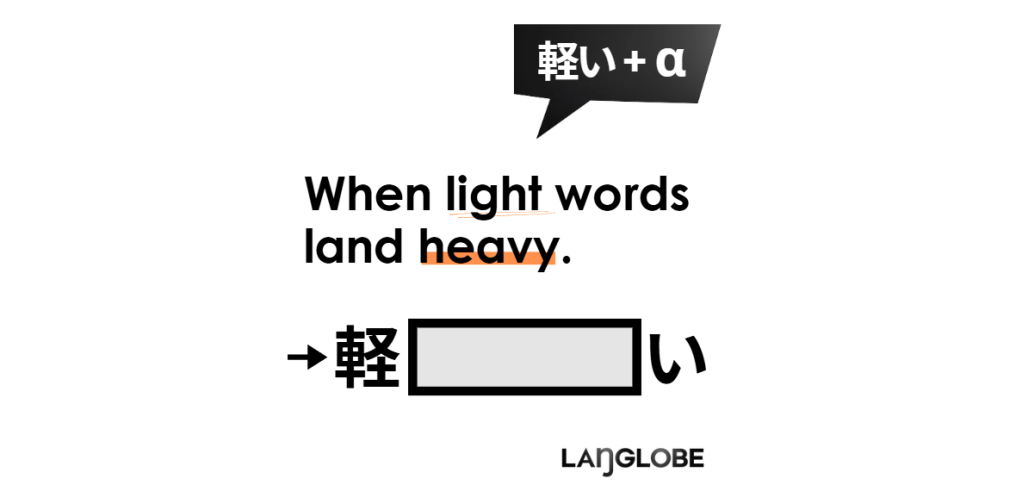
軽々しい(かるがるしい karugarushii)
Literally, it means “light.”
But not the good kind.
It’s what you say when someone speaks too soon, too casually —
about something that deserves care.
There’s no punch. No insult.
Just the dull ache of someone crossing a line without realizing it.
Example:
他人の失敗を軽々しく(かるがるしく)言いふらすなんて、無神経すぎる。
It’s unbelievably insensitive to casually spread someone’s failure.
Here, it’s not just “careless.”
It means out of line. Unthinking.
Wrong tone, wrong timing.
It’s not rude like 失礼(しつれい).
Not cruel like ひどい.
But it still leaves something heavy behind.
軽々しい = Too quick. Too casual. Too unaware.
When to use it:
– Someone jokes about death, illness, or divorce
– A person brings up trauma like it’s gossip
– They say “It’s not that deep” — but to you, it is.
Why this word matters
Because Japanese doesn’t always confront directly.
But it still knows how to say:
“That wasn’t okay.”
Tone matters. Timing matters.
軽々しい captures the harm that happens in the quiet.
One-line summary
軽々しい: When your words float… but they land heavy.
#Langlobe #JapaneseVocabulary #LearnJapanese #JapaneseForBeginners #JapaneseExpression #RealJapanese #NativeJapanese #LanguageLovers #Multilingual #LearnLanguages #Polyglot

 LANGLOBE® Official(ラングローブ公式)
Leave a comment